iPhone 17’s TrueDepth Camera: STMicroelectronics’ Biggest Infrared Sensor Redesign in Eight Years
5 Min Read January 6, 2026
Apple’s Face ID has become the benchmark for secure, seamless biometric authentication across the smartphone industry. Since its introduction with the iPhone X in 2017, the system’s core infrared (IR) image sensor has remained largely unchanged, evolving through incremental refinements rather than fundamental redesigns. That changes with the iPhone 17 Pro Max.
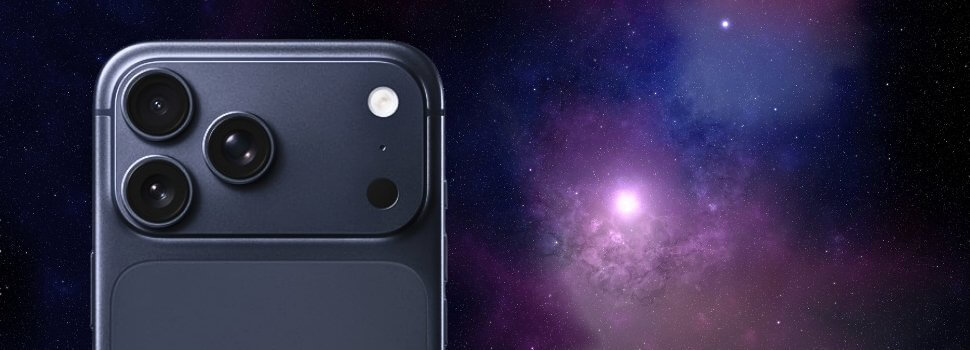
TechInsights’ latest teardown reveals that STMicroelectronics has completely reengineered the infrared image sensor used in Apple’s TrueDepth camera system. This is the most significant architectural update to Face ID imaging hardware in nearly a decade, and its impact extends well beyond faster face unlocking.
Why This Redesign Matters Now
For eight years, the infrared image sensor at the heart of Face ID followed a stable architectural path. While performance steadily improved, the underlying design remained familiar. With the iPhone 17 Pro Max, STMicroelectronics breaks from that pattern by introducing three fundamental architectural changes that collectively represent a major leap in biometric imaging capability.
These changes redefine how infrared light is captured, managed, and converted into electrical signals. The result is higher quantum efficiency, improved performance in low-light and partially occluded conditions, and greater overall reliability. For analysts tracking image sensor technology, smartphone innovation, or biometric security trends, this redesign offers a clear signal of where the industry is headed next.
A Closer Look at the Sensor-Level Innovation
TechInsights’ analysis reveals how STMicroelectronics achieved this breakthrough through a combination of structural and materials innovation. The redesigned sensor demonstrates a new approach to infrared light capture, optimized to maximize signal quality under challenging real-world conditions.
The analysis also examines the advanced materials stack used in the sensor and evaluates how these materials reduce optical loss and electrical noise. A key finding is the integration of a metal-insulator-metal (MIM) capacitor directly into the image sensor, an architectural choice that improves charge handling and signal stability at the pixel level.
What You’ll Find in the TechInsights Exploratory Analysis
TechInsights’ Device Essentials Exploratory Analysis goes far beyond a conventional teardown. Using transmission electron microscopy (TEM) combined with energy-dispersive X-ray spectroscopy (EDS), the report delivers a complete materials and structural characterization of the iPhone 17 TrueDepth infrared image sensor.
The analysis includes precise measurements of every critical layer, with thicknesses documented down to the nanometer. Cross-sectional SEM and TEM imaging reveal the newly implemented Back Deep Trench Isolation (B-DTI) structure and the integrated MIM capacitor in exceptional detail. The report also provides detailed measurements of the optical scattering structures engineered onto the back surface of the sensor.
Each architectural innovation is directly linked to its contribution to improved quantum efficiency and overall sensor performance.
Visual Proof of Performance Gains
The imaging alone provides compelling evidence of why this sensor represents a meaningful advancement. High-resolution cross-sections show precision-engineered optical features on the back surface of the sensor, complete with exact dimensions and angles. These structures explain how the sensor achieves superior infrared light capture, particularly in lighting conditions that traditionally challenge 3D facial recognition systems.
By visualizing these features at the microscopic level, the analysis makes clear that the iPhone 17 TrueDepth camera is the result of deliberate architectural rethinking—not incremental tuning.
Implications Beyond Apple and Face ID
This redesign is not just relevant to Apple or STMicroelectronics. When new image sensor architectures are validated at iPhone-scale production volumes, they tend to influence the broader technology ecosystem.
The innovations demonstrated in the iPhone 17’s infrared image sensor provide an early preview of what’s coming to future smartphones, automotive LiDAR and driver monitoring systems, and AR/VR platforms that depend on high-performance infrared sensing. Understanding these design choices today helps technology leaders anticipate competitive moves, supplier strategies, and product roadmaps over the next 12 to 24 months.
See the Innovation Before the Market Catches Up
Waiting for competitors to interpret these architectural changes first means giving up a strategic advantage.
TechInsights’ iPhone 17 TrueDepth Camera Exploratory Analysis shows exactly how STMicroelectronics achieved its most important infrared image sensor breakthrough in eight years. Access the full analysis on the TechInsights Platform today and gain firsthand insight into the structures, materials, and design decisions shaping the future of biometric imaging.
Create your free account using your corporate email above and start exploring the TechInsights Platform right away. Certain report content may be accessible only to subscribers.
iPhone 17 TrueDepth Camera FAQ: Infrared Sensor Redesign Explained
What changed in the iPhone 17 TrueDepth infrared (IR) image sensor?
TechInsights’ teardown of the iPhone 17 Pro Max shows STMicroelectronics implemented a major, multi-faceted redesign, the most significant IR sensor architecture update since Face ID launched in 2017. The refresh includes structural and materials innovations that increase infrared light capture, reduce noise, and improve signal fidelity.
What are the three fundamental architectural shifts mentioned in the report?
The teardown highlights three core shifts: (1) a redesigned IR light-capture architecture to increase photon absorption, (2) advanced materials engineering to lower optical loss and electrical noise, and (3) the integration of an on-stack Metal-Insulator-Metal (MIM) capacitor to improve pixel-level charge handling and stability.
What is Back Deep Trench Isolation (B-DTI) and why is it important?
B-DTI is an advanced isolation structure revealed in the cross-sectional imaging. It helps isolate pixels electrically and reduce cross-talk, which improves signal integrity, critical for accurate IR/3D sensing and higher quantum efficiency under challenging lighting.
Why is the integrated MIM capacitor significant?
Integrating a MIM capacitor directly into the sensor stack can improve charge storage and handling at the pixel level, reduce noise, and stabilize readout—benefits that translate to more reliable Face ID performance in low light and partial-occlusion scenarios.
What microscopy and analysis methods were used in the TechInsights report?
TechInsights’ teardown of the iPhone 17 Pro Max shows STMicroelectronics implemented a major, multi-faceted redesign, the most significant IR sensor architecture update since Face ID launched in 2017. The refresh includes structural and materials innovations that increase infrared light capture, reduce noise, and improve signal fidelity.
How do the new optical scattering structures improve performance?
Precision-engineered scattering features on the sensor’s back surface alter how infrared light is redirected into active photodiodes, increasing photon capture efficiency and improving sensor sensitivity in low-signal conditions.
Will this redesign affect Face ID speed or accuracy?
The architectural changes aim to increase quantum efficiency and signal quality, which support faster, more reliable Face ID recognition, particularly in low light or partial-occlusion conditions. TechInsights links structural improvements directly to performance gains in the full analysis.
Is this change limited to Apple devices or does it have broader industry impact?
While implemented in Apple’s iPhone 17 Pro Max, innovations validated at iPhone production scale often propagate across the industry. The same architectural advances are relevant to smartphones, automotive LiDAR/driver monitoring, and AR/VR systems.
How far ahead does this insight let product and supply-chain teams plan?
Understanding sensor-level architectural changes provides a 12–24 month strategic view for product planners, competitive intelligence, and supply chain strategy—helpful for anticipating supplier moves and technology roadmaps.
Where can I access the full TechInsights analysis?
The full Device Essentials Exploratory Analysis for the iPhone 17 TrueDepth camera — including SEM/TEM imagery, EDS material maps, layer thicknesses, and measured optical geometries — is available on the TechInsights Platform.
Who should read this report?
Product managers, sensor and optics engineers, hardware strategists, competitive intelligence teams, and procurement/supply-chain leaders focused on smartphone components, LiDAR, AR/VR, and biometric security will find this analysis valuable.
Can TechInsights provide the data in formats suitable for technical teams?
Yes — TechInsights provides detailed imagery, measurement tables, and technical commentary in the Exploratory Analysis. Contact TechInsights sales or your account manager for access and delivery format options.